How much does a luxury move cost in Los Angeles?
Most moving prices published for Los Angeles describe a standard move: a crew, a truck and a few hours of loading. A luxury or white glove move is a different job, so it sits in a different price band.
For local moves within Southern California, the table above gives typical ranges by home size. A condo or two-bedroom home runs about $3,500 to $7,500. A three- to four-bedroom house runs $7,500 to $18,000, and a larger home or estate $18,000 to $60,000 or more.
A 3,000 square foot house is usually three or four bedrooms, which puts a white glove move in the $7,500 to $18,000 band. Where it lands depends on how much needs packing, how many pieces need crates and how hard the house is to reach.
These are planning ranges, not quotes. A white glove move is priced after a walkthrough, and the written estimate is the number that counts. For what sits inside that number, see our white glove moving service.
What do standard movers charge in Los Angeles?
For context, here is what published guides say about standard full-service moves:
- moveBuddha puts the Los Angeles average at $100 an hour for a two-person crew, with local moves of $1,458 to $2,430 for three bedrooms and $1,944 to $3,564 for four or more.
- Royal Moving & Storage, in its 2026 Los Angeles cost guide, quotes $110 to $160 an hour for two movers with a truck, $140 to $210 for three, and $1,500 to $3,000 for a three-bedroom home.
- Forbes Home puts local movers nationally at $40 to $80 an hour per mover, and up to $150 for certain needs or locations.
California also sets maximum hourly rates. Under the state’s MAX 4 tariff, effective January 1, 2026, the straight-time maximum in Territory B, which includes Los Angeles County as well as Orange County, is $215.48 an hour for a truck with two movers, plus $72.71 for each additional mover, and $82.56 an hour per packer. On hourly moves, billable time is loading, unloading and double the driving time between the two homes. A mover may charge more than those rates only after issuing a written estimate at least three days before the move.
Why do white glove moves cost more?
The difference is mostly in the hours and the headcount. A standard crew pads the furniture and loads the truck. A white glove move adds work a standard move never includes, which is why it helps to know what white glove moving includes before comparing quotes:
- Protection first. Floor runners, door jamb covers, banister wraps and elevator pads go down at both homes before anything moves.
- Packing at scale. Packing a large home room by room, with wardrobe cartons and dish packs, can take its own crew and its own day before the truck arrives.
- Crating. Art, stone tops, mirrors, glass and chandeliers travel in crates built to their dimensions, each priced by size and build.
- The finish. Furniture placed to a floor plan, beds assembled, cartons unpacked and every pad and box taken away.
- Coordination. The inventory, building and HOA paperwork, parking signs and gate lists all have to be arranged before move day.
- Higher declared values. Covering a collection at its real value costs more than basic coverage.
If most of what you own is easy to replace, a standard full-service move may be all you need. The premium earns its keep when one damaged piece would cost more than the difference.
What drives the price of a move in Southern California?
- Crew size and hours. Hourly moves are billed by the crew-hour, so a larger home or a tighter window means more movers, a second truck or a second day.
- Access. Hillside drives in Bel Air, the Hollywood Hills and the Malibu canyons often need a smaller shuttle truck between the street and the door. Popeye Moving & Storage puts shuttle service in Los Angeles at $250 to $500 per trip. High-rise buildings want elevator reservations, loading dock times and a certificate of insurance, and gated communities set their own vendor rules and move hours.
- Crating. Safebound’s pricing guide puts custom crates at $75 to $150 for a small framed painting and $300 to $600 for a large marble tabletop or oversized artwork. Collections get their own plan under fine art moving.
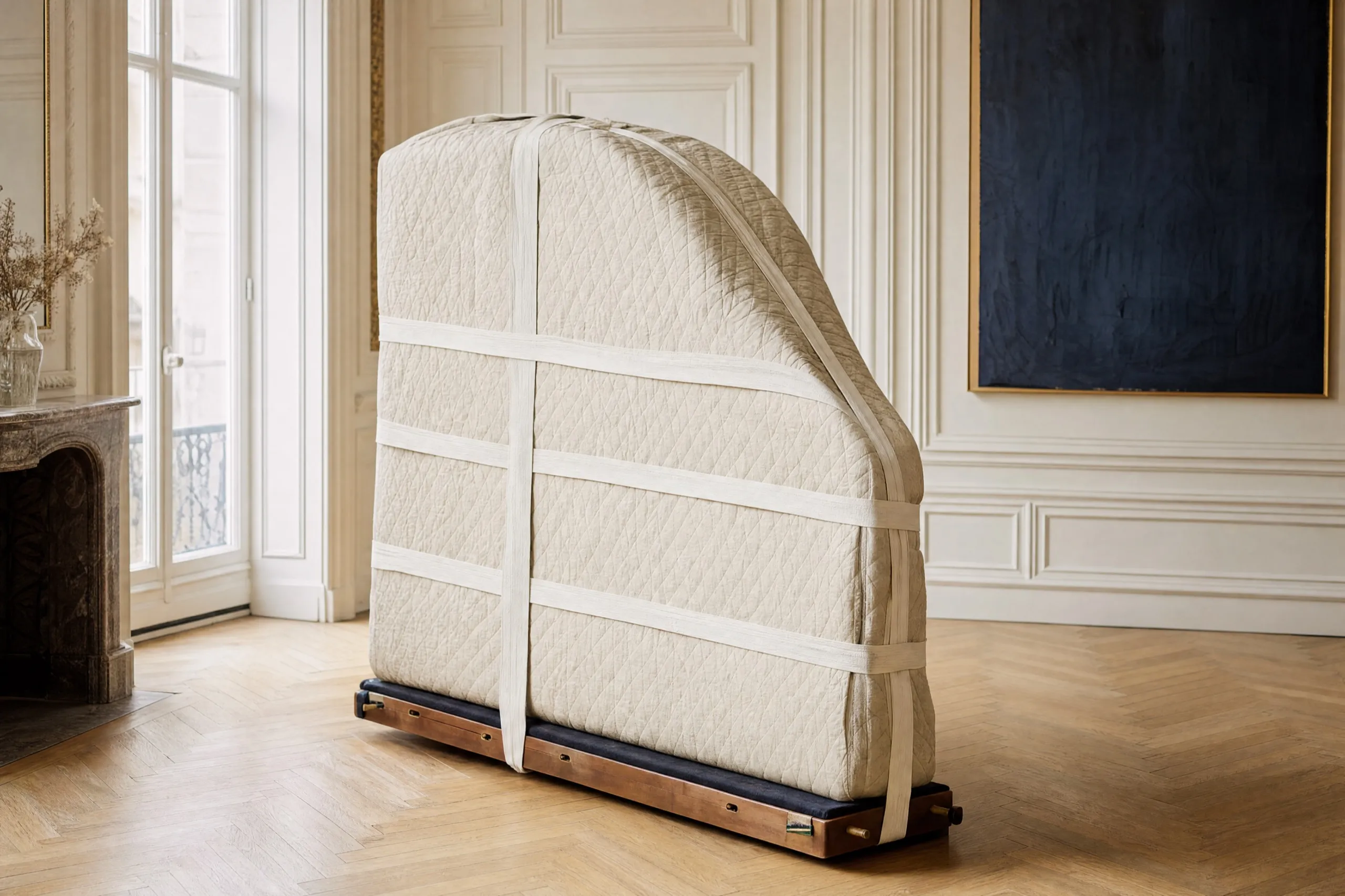
- Pianos. HomeAdvisor puts a local grand piano move at $350 to $650.
- Storage. Forbes Home puts storage units at $50 to $300 a month. Full-service storage, where the mover inventories and warehouses your things, is quoted separately; see storage between homes.
- Time of year. moveBuddha puts peak season at May through September, at 20 to 30 percent above off-season rates, with the end and start of each month the busiest dates.
- City rules. Beverly Hills limits residential moves to 8 a.m. to 6 p.m., so a large home there gets a bigger crew or a second day. See moving in Beverly Hills and Bel Air.
- Valuation coverage. Covered in its own section below.
How do moving estimates work in California?
The Bureau of Household Goods and Services (BHGS) regulates household movers in California, and its MAX 4 tariff sets the rules for estimates:
- Inspection first. An estimate must be in writing and given only after the mover sees the goods (Item 108). The BHGS moving tips flyer calls it “illegal to provide an estimate without a visual inspection” and recommends an in-person inspection rather than video or photos.
- A Not to Exceed Price. Normally at least three days before the move, the mover must give you an Important Notice About Your Move with a Not to Exceed amount, which also goes on your Agreement for Moving Services. It is the most you can be charged (Items 128 and 130).
- Change orders for additions. The total can rise only through a signed Change Order for Services covering items or services you add, before that work starts (Item 120).
- A flat price, if you agree. You and the mover can agree that the estimate is both the minimum and the maximum, so you pay exactly the estimate (Item 108).
- A permit you can check. Every household mover in California needs a BHGS permit, shown as a CAL-T number. Look it up with the BHGS license search.
“Binding” and “non-binding” estimates are federal terms for interstate moves, under 49 CFR Part 375. For a move within California, the number to find on the paperwork is the Not to Exceed Price.
Why is a walkthrough better than a phone quote?
Within California, a price quoted over the phone is not a valid estimate at all. It also misses what drives the price. The tariff tells estimators to account for flights of stairs, long carries, elevators and hoisting, none of which shows up on a call.
A walkthrough finds the armoire that will not turn at the stair landing, the paintings that need crates, the building’s elevator rules and the spot where the truck can stand. A price given without seeing the home is a guess, and a low guess helps no one on move day. For a large home, do it in person. When you are ready, request a walkthrough and written estimate.
How much does valuation coverage cost?
Valuation is the mover’s liability for loss or damage, set out in MAX 4 Item 136:
- Basic: 60 cents per pound per article, at no extra charge. A 100-pound marble console is worth $60 in a claim.
- The default. If you do not write in a declared value, coverage defaults to actual cash value up to $20,000.
- Actual Cash Value. Maximum fixed rate of $1.12 per $100 of declared value.
- Full Value, if the mover offers it. Replacement, reimbursement or repair, at a maximum fixed rate of $2.20 per $100, or $0.67 with a $250 deductible and $0.38 with a $500 deductible.
At those maximum rates, $250,000 of Full Value protection comes to $5,500, or $950 with the $500 deductible. Ask your insurance broker whether your homeowner’s or collection policy covers items in transit, and settle the valuation choice in writing before move day.
How much should you tip movers?
Tipping is optional. NerdWallet calls it customary rather than required and lists three common methods: $20 to $50 per mover per working day, $4 to $15 per mover per hour, or 10 to 20 percent of the moving cost. Royal’s Los Angeles guide suggests $20 to $40 per mover for a half day and $40 to $60 for a full day.
On a white glove move, the percentage method gets out of proportion: 10 percent of a $30,000 estate move is $3,000. A per-mover, per-day amount is easier to size, adjusted for the length of the day, stairs and heavy or delicate pieces.
Is $100 enough to tip movers? For one mover on a full day, yes; it is above the common ranges. Across a four-person crew it is $25 each, at the low end for a full day. Hand it to each mover, or to the crew lead to share, at the end of the day.